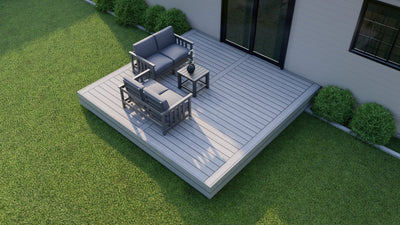
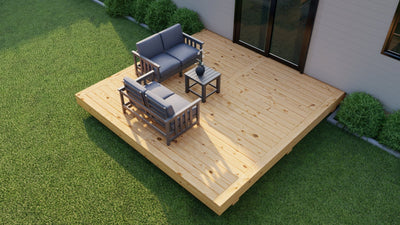
Deck Builders in Virginia: VA Deck Costs, Permits and a Faster Way to Build

Most Virginia deck projects start with the same decision: hire a licensed deck builder, buy lumber and hardware and build from scratch, or order a professionally engineered deck kit that arrives with its components prepared for assembly.

Below you will find how each route works in Virginia, what drives the price, how the Uniform Statewide Building Code and local permit offices fit in, what to check before signing with a contractor and how pressure-treated wood compares with composite in Virginia’s humid, coastal-to-mountain climate.

A-DIY is the third route. We engineer the deck, prepare the components and deliver the complete system to your property. From there you can assemble it yourself with a drill or bring in a local handyman, carpenter or contractor to do it for you.

A-DIY pressure-treated wood deck with outdoor lounge seating and a fire pit in a backyard

Three Ways to Build a Deck in Virginia

Hire a Full Service Deck Contractor

A deck builder can manage design, materials, permits, foundations, construction, inspections and cleanup. This is often the best choice when the project is highly customized or the homeowner wants one company to manage the entire job.

Build From Raw Materials

The homeowner or builder purchases lumber, hardware and decking separately, then handles the design, measurements, cuts, structural layout and assembly. This approach offers flexibility but requires more planning and construction knowledge.

There’s the old way. And there’s A-DIY.

FEATURE A-DIY logo A-DIY SYSTEM Traditional DIY Contractor
Price 30-50% less Costs vary, often higher than expected Paying premium for time and labor
Time to Build Few Hours Endless weekends, losing precious time Weeks of waiting and delays
Family Time More time to create memories Missed moments with loved ones Time spent coordinating and stressing
Ease & Convenience Like LEGO for adults Frustrating and overwhelming Stressful scheduling and oversight
Fulfillment Instant gratification Frustrating trial and error Watching someone else do it
Customization Tailored to your dreams Depends on skill and time Limited by budget and contractor
Stress Level Low — focus on what matters High — unexpected complications High — unforeseen challenges
Memories Building together, bonding Struggling, less time to enjoy Waiting, watching, worrying
Learn more

How Do You Find and Hire a Deck Contractor in Virginia?

Start by defining the project before collecting estimates. Contractors cannot provide directly comparable quotes when each is pricing a different size, material, height or scope of work.

Prepare a short written description containing:

  • Approximate deck dimensions
  • Preferred material
  • Proposed height
  • Attached or freestanding design
  • Stairs and railings
  • Existing deck removal
  • Site conditions
  • Permit responsibility

Then collect multiple written estimates and compare the same scope.

The Virginia Department of Professional and Occupational Regulation (DPOR) advises homeowners to get at least three written estimates on identical specifications, call local references, verify the license through DPOR License Lookup and insist on a detailed written contract before hiring.

What Should You Verify?

  • Business identity and address
  • Active DPOR contractor license (Class A, B or C)
  • Liability and workers’ compensation coverage
  • Recent references and completed projects
  • Written project scope
  • Payment schedule
  • Warranty terms
  • Expected start and completion dates

In Virginia, any contractor performing work valued at more than $1,000 must hold a license from the DPOR Board for Contractors: Class C for projects over $1,000 but under $30,000, Class B from $30,000 to under $150,000 and Class A for $150,000 or more. State law requires licensed contractors to give homeowners a written contract for residential work, and DPOR recommends keeping the initial deposit to roughly 10% of the price.

What Should a Written Deck Quote Include?

  • Deck dimensions and layout
  • Lumber grade and framing dimensions
  • Surface material and brand
  • Hardware and connectors
  • Footings, posts and bracing
  • Stairs and railings
  • Permit and engineering responsibility
  • Demolition, disposal and cleanup
  • Schedule, payments and warranty
  • All exclusions and allowances

Essential Questions to Ask

Have you completed similar decks in this city or county?

Are you licensed or registered where required?

Can you provide current proof of insurance?

What lumber, framing dimensions and decking product are included?

What foundation system is proposed?

Who handles permits, plans and inspections?

Are stairs, railings, demolition and cleanup included?

How are changes and unexpected work priced?

What is the payment schedule?

What workmanship and material warranties apply?

Virginia Deck Permits

A new deck in Virginia almost always needs a building permit, and the details depend on your locality, the deck’s height and whether it attaches to the house.

The Virginia Uniform Statewide Building Code (USBC) applies in every city, county and town in the Commonwealth. Detached one- and two-family homes follow its Virginia Residential Code, currently the 2021 edition. State law places enforcement with the local building department, so your city or county reviews the plans, issues the permit and performs the inspections rather than a state office.

Footing depths, plan requirements and fees vary from one locality to the next.

Exploded engineering diagram of an A-DIY deck kit showing decking, joists, beams and footings

Questions to Ask the Building Department

  • Does the proposed deck require a permit?
  • Is zoning approval, a site plan or a survey required?
  • What setbacks apply?
  • Are stamped plans required?
  • What footing information must be submitted?
  • What inspections are required?
  • Are stairs or railings required at the proposed height?
  • Can the homeowner perform the work?

Virginia Beach

In Virginia Beach, deck permits are handled by the Permits and Inspections Division of the Planning Department, with applications submitted through the city’s Accela Citizen Access portal. The city requires a permit for any new deck regardless of size or height, schedules footing, framing and final inspections, and may require additional environmental approvals for properties in flood zones or the Chesapeake Bay Preservation Area.

What Do A-DIY Engineering Diagrams Show?

Pressure-treated A-DIY deck sections stacked before assembly

Diagrams for an applicable A-DIY configuration may show:

  • Overall dimensions and structural layout
  • Beam and joist locations
  • Post locations
  • Lumber dimensions and type
  • Major connections
  • Assembly configuration

The building department may still request property specific information, such as a survey, site plan, setbacks, foundation details, stairs, railings, attachment details or professionally stamped documents.

Requirements vary by municipality, and the local building department has final authority. A-DIY diagrams can support a permit application but do not guarantee approval.

"The instructions were spot on and every piece fit perfectly. It was so easy to build… just like a Lego set. I highly recommend A-DIY!"
— Patrick Mungovan, A-DIY customer

Which deck is right for you?

Wood or composite. Two ways to make it yours. One remarkably simple way to build it.

Every A-DIY deck includes:

Engineered for

Engineered for

15,000+ lbs

Assembles in a

Assembles in a

few hours

Grade 1 Treated &

Grade 1 Treated &

Kiln-Dried Lumber

Professional-grade

Professional-grade

structural system

5-year structural

5-year structural

warranty

Engineered for

Engineered for

15,000+ lbs

Assembles in a

Assembles in a

few hours

Grade 1 Treated &

Grade 1 Treated &

Kiln-Dried Lumber

Professional-grade

Professional-grade

structural system

5-year structural

5-year structural

warranty

Best Selling

Wood Deck Kit

From$3,699.00

Grade 1 Southern Yellow Pine. Pressure Treated and Kiln Dried.

SHOP NOW →

Real wood beauty

Authentic Southern Yellow Pine with the warmth, texture, and character only real wood can offer.

Kiln-dried, pressure-treated lumber

Grade 1 lumber engineered to help reduce warping, twisting, and shrinking over time.

Finish it your way

Can be stained or sealed to match your home, your backyard, and your style.

Lower upfront investment

A more budget-friendly way to get a professional-grade deck system.

Ongoing maintenance required

Best for homeowners who don’t mind occasional sealing, staining, and upkeep.

Best for:

Homeowners who want the natural look of real wood and more flexibility at a lower starting price.

LOW MAINTENANCE

Composite Deck Kit

From$5,700.00

Engineered For Lasting Beauty.

SHOP NOW →

Premium wood-inspired finish

Rich, natural-looking colors designed to deliver the look of wood with a more refined finish.

Low-maintenance surface

No sanding, staining, or sealing required

Fade and splinter resistant

Built to stay beautiful season after season with less upkeep.

25-Year Warranty

Structural, stain & fade warranty on composite boards.

Premium long-term ownership

A higher-end option for homeowners who want less maintenance and more convenience.

Best for:

Homeowners who want the look of wood without the regular upkeep.

Uneven Ground, Elevated Decks and Foundation Options

An A-DIY deck may be installed over sloped or uneven ground by adjusting the supporting post heights to establish a level deck surface.

Elevated A-DIY deck with stairs and railings beside a home
A-DIY deck on adjustable posts over sloped ground
UP TO APPROX. 40inches Supported elevation

Supported Elevation

Supported configurations may be elevated to approximately 40 inches using the appropriate posts, foundations and bracing.

Depending on the height and configuration, the project may also require:

  • Longer posts
  • Additional bracing
  • Stairs
  • Railings
  • Additional engineering
  • Permit approval

Foundation and Footing Options

Depending on the property, configuration and local approval, suitable systems may include:

  • Sonotubes
  • Helical piles
  • Ground screws
  • In-ground posts
  • Approved surface footing systems
  • Other site-specific foundations

How Does A-DIY Work?

  1. PLAN

    Choose the Size and Material

    Select an available deck size, pressure treated or composite surface and applicable options.

  2. PLAN

    Review the Property

    Confirm the available space, ground conditions, slope, proposed height, drainage and delivery access.

  3. PLAN

    Confirm Permits and Foundations

    Contact the local building department and select a suitable foundation system for the property.

  4. DELIVER

    Receive the Deck Kit

    The coordinated components are delivered to the property.

  5. BUILD

    Assemble It or Hire Local Help

    Complete the assembly yourself or hire a local handyman.

  6. BUILD

    Complete Required Inspections

    Arrange any inspections or final approvals required by the municipality.

A homeowner assembling A-DIY deck joists beside a travel trailer
WATCHHow Does A-DIY Work

Engineering, Strength and Warranty

A-DIY deck configurations are professionally engineered.

A pickup truck parked on an A-DIY deck during a load test
STRUCTURAL RATING

Verified Structural Rating

Applicable A-DIY deck configurations are engineered to hold up to 15,000 pounds when properly assembled, supported and installed according to the applicable specifications.

Structural performance depends on correct assembly, the selected configuration, suitable foundations, footing installation, site conditions, post height, bracing, connections and compliance with applicable engineering information.
WARRANTY

Five-Year Structural Warranty

A-DIY deck systems include a five-year structural warranty, subject to the written terms, approved uses, correct installation, limitations and exclusions.

Composite surface boards come with a 25 years manufacturer warranty.Review warranty

Building a Deck Across Virginia

From salt air and hurricane-season winds along the Hampton Roads waterfront to freeze-thaw winters in the Shenandoah Valley, our kits are engineered for the varied conditions Virginia homeowners build in.

Don’t see your community? A-DIY can still deliver to your area.

Frequently Asked Questions

Who builds decks in Virginia?

Virginia homeowners have three choices: a DPOR-licensed deck contractor, a do-it-yourself build from raw lumber, or an A-DIY engineered deck kit. A-DIY ships the complete deck system to your home, and you, a friend or a local handyman can put it together in a few hours using only a drill.

How much does it cost to build a deck in Virginia?

Contractor pricing in Virginia varies with deck size, material, height, site conditions and regional labor rates, and quotes in the Northern Virginia suburbs are usually among the highest in the state. A-DIY deck kits start at $3,699 for pressure-treated wood and $5,700 for composite, typically 30–50% less than hiring a contractor. Use our deck cost calculator to compare prices in your area.

Is there a cheaper alternative to hiring a deck builder in Virginia?

Yes. With an engineered deck kit you get a genuine structural deck without paying for a contractor’s design hours and full crew labor. Every A-DIY kit arrives complete, footings included, so there is nothing to measure, cut or source on your own.

Is A-DIY a Virginia deck contractor?

No. A-DIY does not build or install decks and does not hold a Virginia contractor license. We engineer and deliver complete deck kits to any address in the Commonwealth. Assemble it yourself or hire any local handyman, carpenter or licensed contractor to assemble it for you.

Can I hire someone to assemble an A-DIY deck?

Yes. Plenty of Virginia homeowners bring in a local handyman to assemble their A-DIY kit. Since the components arrive prepared for assembly with step-by-step instructions, the job takes far less time than a custom build, which keeps the labor bill small.

Do I need a permit to build a deck in Virginia?

Almost always, yes. Decks are not on the Virginia Construction Code’s list of work exempt from permits, so your city or county will normally require one before you build. The Virginia Uniform Statewide Building Code sets the rules, and the local building department issues the permit and performs the inspections. Check with your locality before you order or start work.

What are the deck permit rules in Virginia Beach?

Virginia Beach requires a building permit for every new deck, whatever its size or height. Applications go through the Permits and Inspections Division of the Planning Department using the Accela Citizen Access portal, and the city inspects footings, framing and the finished deck. Waterfront and flood-zone properties may need extra environmental approvals first, so contact Permits and Inspections early.

How deep do deck footings need to be in Virginia?

Under the Virginia Residential Code, footings for a deck supported by the house must extend below the frost line set by your locality, which is typically 18 or 24 inches depending on where you live. Decks that are not supported by a dwelling are excepted from the frost-depth rule, although many localities still set a minimum footing depth, so always confirm with your building department.

Can I build a deck on uneven or sloped ground in Virginia?

Yes. An A-DIY deck can be installed over sloped or uneven ground by adjusting the supporting post heights to create a level deck surface. Supported configurations can be elevated to approximately 40 inches using the appropriate posts, foundations and bracing.

Which footings come with an A-DIY deck?

Every A-DIY kit includes Tuff Block footings. Depending on your property, deck height and local requirements, other foundation systems may be used instead, such as sonotubes, helical piles, ground screws, in-ground posts or approved surface footing systems.

Is pressure-treated wood or composite better for Virginia weather?

Both perform well in Virginia. Pressure-treated wood is the lower-cost option and takes stain or sealer, but Virginia’s hot, humid summers, 40 to 50 inches of annual rain, moderate-to-heavy termite exposure and salt air near the coast mean it needs regular upkeep. Composite costs more upfront but never needs sanding, staining or sealing, resists fading and splintering, and its boards carry a 25-year warranty.

How strong is an A-DIY deck?

Applicable A-DIY deck configurations are engineered to hold up to 15,000 pounds when properly assembled, supported and installed according to the applicable specifications. Every A-DIY deck system also includes a five-year structural warranty.

How long does delivery to Virginia take?

A-DIY delivers across Virginia, from Hampton Roads to Northern Virginia and the Roanoke Valley, typically within 10–14 business days. Every component and all hardware arrive together, so you can begin assembly the day the kit shows up.

Can I finance a deck in Virginia?

Yes. You can choose Build Now, Pay Later financing through Affirm (subject to approval), 0% split payments over up to eight months, or A-DIY Reserve, a $250 deposit that locks in today’s price for a future delivery date.

Can A-DIY engineering diagrams help with my permit?

Yes. Diagrams for an applicable A-DIY configuration show dimensions, structural layout, beam, joist and post locations, lumber sizes and major connections, which can support your permit application. Your building department may still request a survey, site plan or stamped documents, and approval is not guaranteed.

Build the Deck You Need. Your Way.

A-DIY gives Virginia homeowners a practical middle path between paying for a fully custom contractor build and starting from a pile of loose lumber.

Pick your size and material, look over the engineering information available for your configuration and decide whether you will assemble it yourself or hire local help.

No cutting

Every part is precision cut and engineered to fit seamlessly.

No measuring

Follow the step by step instructions and all parts fit together like lego.

No guesswork

3D instructional app, guiding you step by step for a seamless build.

Explore Deck Kits