






5 Ways to Save Money When Building A Deck For Your Home
Share
The average deck costs between $8,000 and $12,500 in 2026. That's a significant investment. But what most contractors won't tell you is that labor typically makes up 40-50% of your total deck cost. We're talking about thousands of dollars that could stay in your pocket without sacrificing the quality of your deck.
After helping over 50,000 homeowners build beautiful outdoor spaces, our team at A-DIY has identified five proven strategies that can save you anywhere from $6,000 to $12,000 on your deck project.
Let's dive in.
How You Can Save Money When Building A Deck
1. Stop Paying Someone Else to Do What You Can Do Yourself
We get it. Building a deck from scratch sounds intimidating. However, when you hire a contractor for a basic 12x16 deck, you're typically paying $8,000 to $15,000. The materials for that same deck will maybe cost around $2,000 to $3,000. The rest is their time, crew, markup, and overhead. Which is fine - they've got to make a living. But that's also several thousand dollars you could save if there were an easier way to do it yourself.
The problem with traditional DIY has always been the skill gap. Unless you're already pretty handy with carpentry, you're setting yourself up for a frustrating couple of weekends. And there's always that nagging worry - did I do this right? Is this thing going to collapse when I have eight people over for a cookout?
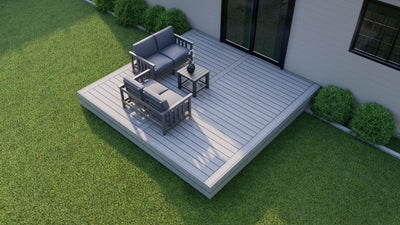
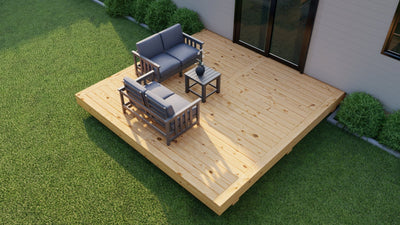
This is where things have changed a lot in recent years. Pre-engineered deck kits basically took all the hard parts out of the equation. The panels come already assembled. Everything's pre-cut. You're basically putting together large puzzle pieces, except the instructions actually make sense.
One of our customers, Steve, said he's definitely the least handy person around. He put his deck together in under an hour. The whole thing cost him a fraction of the contractor's quote.
When you break down what you're actually paying for with an A-DIY kit, you're getting professional-grade engineering without paying for someone else's labor. Plus, we'll help you design it for free, which contractors usually charge a few hundred bucks for.
2. Think About Five Years From Now, Not Just Today
People usually see cheap pressure-treated lumber and think they're being smart about money. And then two years later, they're spending their Saturday staining the whole deck. Again. Because that's just what you do with cheap wood.
Standard pressure-treated lumber is still wet when they sell it is sold to you. As it dries out over the next few months, it warps and cracks. Boards start looking rough. So you're staining it every year, maybe every other year if you're lucky. You're replacing warped boards here and there.
At A-DIY, we use KDAT lumber in our pressure treated kits. That stands for Kiln-Dried After Treatment, which basically means the wood is actually dry and stable when you get it. It warps way less; we're talking 70% less than the standard stuff. You'll still need to maintain it, but you're doing it maybe once every couple of years instead of annually.
3. Keep It Simple, You'll Save Thousands
Multi-level decks with curves and fancy angles look great, but they also cost a fortune because every angle cut, every curve, every additional level adds complexity. And complexity means labor hours. And labor hours mean money flying out of your wallet.
A simple ground-level deck saves you money in ways you might not have thought about. You skip stairs entirely, which is easily $800 to $1,500. In most places, if your deck is low enough to the ground, you skip deck railings, too. That's another $1,200 to $2,400.
I know what you're thinking. "But won't a simple rectangle look boring?"
Only if you want it to. We've seen people add built-in planters, integrated benches, and nice lighting to their new deck. The deck itself might be a rectangle, but it definitely stands out. Lori built hers in a few hours and saved over five grand compared to what contractors quoted her. She said she couldn't be prouder of it, and honestly, when you look at the photos, you can see why.
The modular deck design makes this even easier. Start with whatever size makes sense for your space right now. Want to expand it next summer? Add another module. It's way more flexible than committing to some massive project all at once.
Most people really only need about 150 to 200 square feet for comfortable entertaining anyway. A 12x16 deck handles six to eight people easily and costs under three grand with a kit. Building bigger just because you can is how budgets balloon.
One of our customers, Mathew, works in construction, so he notices this kind of thing. He called our deck "a testament to sound engineering," which, coming from someone who builds stuff for a living, feels pretty good.
If you really want to minimize maintenance, composite deck construction is the way to go. Higher upfront cost, sure. But you're basically done after installation. It just sits there and looks good for decades. Our composite option runs a bit more initially, but when you factor in all those weekends you won't spend staining, the math works out.
4. Watch Out for the Costs Nobody Mentions
Permit requirements and local building codes can run you a few hundred dollars, depending on where you live. Tools you don't own might cost another few hundred to rent or buy. Then there's all the material you'll waste when you cut things wrong or order too much or too little.
The thing about ground-level modular decks is that in most jurisdictions, they're permit-exempt if they're under a certain size. That's a couple of hundred bucks you just saved by default.
The material waste gets people all the time. You order lumber, make some cuts wrong, realize you needed one more deck board for the deck frame, head back to the store, and buy more than you need to avoid another trip. Before you know it, you've blown an extra 15 or 20 percent of your budget on stuff you'll never use. Pre-cut deck kits eliminate that completely.
We've also seen people run into site prep issues. Uneven ground that needs excavation. Drainage problems. Tree roots in the way. Our DIY deck kits actually adjust to uneven ground pretty well, so you skip the expensive grading work.
When you add all these hidden costs up, you can easily burn through an extra thousand to fifteen hundred dollars on top of your material costs.
5. Look at the Whole Picture, Not Just the Price Tag
A $6,000 deck that needs constant maintenance ends up costing way more than a $4,000 deck that basically takes care of itself. But people get tunnel vision on that initial number.
Let's say you go the budget contractor route with standard materials. You're in for $6,000 up front. Then you're maintaining it every year - a couple of hundred bucks for staining, sealing every few years, replacing boards when they warp. Over ten years, you're looking at thirteen or fourteen thousand dollars total.
Compare that to an A-DIY composite deck kit at around $4,200 up front. Maintenance costs are minimal - maybe you clean it once in a while. The total ten-year cost comes in around $5,200. You actually spend less money overall with the more expensive upfront option.
Plus, there's the time factor. Contractors take weeks, and you're coordinating schedules, dealing with delays, hoping they show up when they say they will. Traditional DIY takes multiple weekends, assuming you know what you're doing. With a modular kit, you're done in an hour or two and using your deck that same day.
So What Does This All Mean?
If you follow what I just laid out, you're saving somewhere between six and twelve thousand dollars compared to hiring a contractor. That's a vacation.
The thing is, all five of these strategies are baked into how A-DIY modular deck kits work. You're getting professional-quality engineering at DIY prices because you're just cutting out all the expensive, complicated parts of traditional deck building.
We've done this fifty thousand times at this point. It works. People save an average of 40% compared to contractor builds, and they end up with decks that last just as long, if not longer, because the materials and engineering are actually better.
Talk to our design team for free, and they'll show you exactly what you'd save on your specific project. Or just browse the kits and see what makes sense for your space. Either way, you'll be way ahead of where you'd be going the traditional route.