


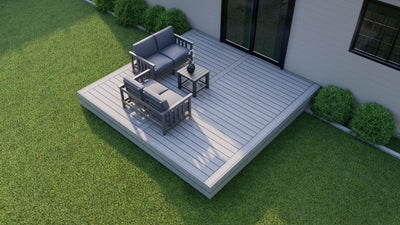


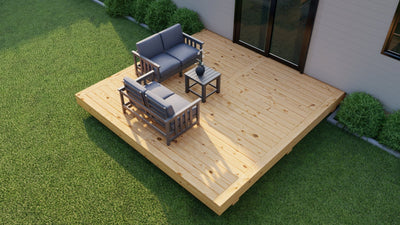


PVC Decking vs Composite Decking: Which Material Is Right for Your DIY Deck?
Share
You've decided to build a deck, you're ready to skip the contractor, and you're staring at two popular options: PVC and composite. Both promise low maintenance and long-lasting performance.
So, what's the real difference between PVC and composite decking material, and which one actually makes sense for your backyard project?
In my experience, both materials have their place, but for most DIY homeowners, one clearly offers better value, easier installation, and more natural aesthetics.
By the end of this guide, you'll know exactly which material fits your budget, lifestyle, and skill level, and why we chose to build our A-DIY deck kits exclusively with premium composite materials.
What You Need to Know Before Choosing Your Deck Material
Why Material Choice Matters for DIY Projects
If you're hiring a contractor, they'll work with whatever material you choose. They have the tools, the experience, and the crew to handle it. But when you're building it yourself, the material's weight, workability, and assembly requirements suddenly become very important.
Think about it. A material that requires special cutting tools or professional installation techniques isn't really "DIY-friendly," no matter how good the marketing claims sound. You want something that's forgiving during installation, won't require you to rent expensive equipment, and can be assembled in a reasonable timeframe.
What Is Composite Decking? (And Why It's Built for DIYers)
Let's talk about composite first, since it's what most DIY homeowners end up choosing, and for good reason.
How Composite Decking Is Made
Composite decking is a blend of wood fibers and recycled material, typically combining 50-70% wood with 30-50% high-density polyethylene (HDPE) plastic. This combination gives you the best of the natural look and feel of wood, with the durability and low maintenance of synthetic materials.
Most quality composite boards are "capped," meaning they have a protective plastic shell around the wood-plastic core. This cap protects against moisture, stains, and fading, giving you the performance benefits without sacrificing the wood-like appearance.
Why Composite Appeals to DIYers
If you're planning to build your deck yourself, composite has some serious advantages.
-
Weight: Composite boards are lighter than traditional pressure-treated wood, making them easier to carry, position, and install.
-
Workability: You can cut composite boards with standard power tools (circular saw, miter saw), drill pilot holes easily, and even modify boards on-site if needed.
-
Flexibility: The material has a slight flex to it, which actually makes installation easier.
-
Forgiving Nature: Made a measurement error? Composite is easier to adjust and work with compared to more rigid materials.
At A-DIY, we chose composite for our deck kits specifically because it strikes the perfect balance of durable enough to last decades, light enough for easy assembly, and natural-looking enough to beautify any backyard. After building thousands of decks with homeowners, we know what works, and composite delivers every time.
What Is PVC Decking?
The Composition of PVC Deck Boards
PVC decking is 100% polyvinyl chloride, the same material used in plumbing pipes, vinyl fencing, and other outdoor products. There are no wood fibers whatsoever. Instead, manufacturers use foaming agents to create a cellular PVC structure that's lighter than solid plastic while maintaining strength.
Because there's no organic material, advanced PVC decking is completely impervious to moisture. It won't rot, warp, or harbor mold. In extreme moisture environments, this is a legitimate advantage.
When PVC Makes Sense
Let's be clear, I won't say PVC is a bad material for decking. It's excellent for specific applications.
Extreme Moisture Environments: Building a dock? Poolside deck in Florida? Coastal property with constant salt spray? PVC's 100% moisture resistance.
Maximum Moisture Protection: Zero organic material means zero chance of moisture-related issues, period.
Although PVC board is impressive technology, it's not the only—or even the best—solution for most backyard deck projects. For a typical residential deck that's protected from extreme elements, you're paying a premium for performance you probably don't need.
The Difference Between Composite and PVC Decking: The Side-by-Side Comparison
|
Factor |
Composite Decking |
PVC Decking |
|---|---|---|
|
Material Composition |
Wood fibers + plastic blend (50-70% wood) |
100% polyvinyl chloride (no wood) |
|
Typical Lifespan |
25-30 years |
50+ years |
|
Cost per Square Foot |
$5-7 |
$10-12 |
|
DIY Installation |
Easier to work with standard tools |
More rigid, harder to cut and modify |
|
Weight per Board |
Moderate (manageable for 1-2 people) |
Lighter, but less flexible |
|
Appearance |
Natural wood look with wood grain patterns |
Can appear synthetic/uniform |
|
Maintenance Required |
Low (occasional cleaning) |
Very low (rare cleaning) |
|
Moisture Resistance |
Excellent (when capped) |
Superior (100% waterproof) |
|
Temperature Stability |
Good (minimal expansion/contraction) |
Fair (expands more in heat) |
|
Best For |
Most residential decks & DIY projects |
Extreme moisture areas, commercial |
PVC vs Composite Decking: Cost Comparison
Let's talk money, because this is where the rubber meets the road for most homeowners.
Material Costs Breakdown
On average, PVC decking costs 30-50% more than comparable composite materials. For a standard 200 square foot deck:
-
Composite materials: $1,000-1,400
-
PVC materials: $1,600-2,400
The Installation Cost of PVC and Composite Decking Boards
Professional contractors typically charge $8-15 per square foot for installation. That's on top of material costs. And, PVC is often harder to work with than composite, sometimes requiring specialized tools or techniques that can push costs even higher.
Let's look at real numbers for that 200 square foot deck:
PVC Option:
-
Materials: $1,600-2,400
-
Professional installation: $1,600-3,000
-
Total: $3,200-5,400
Traditional Composite Option:
-
Materials: $1,000-1,400
-
Professional installation: $1,600-3,000
-
Total: $2,600-4,400
A-DIY Composite Kit (DIY):
-
Complete kit: $1,000-1,400
-
Installation: $0 (you build it yourself in under an hour)
-
Total: $1,000-1,400
You're looking at $1,800-4,000 in savings compared to hiring a contractor for either material. And compared to PVC with professional installation? You save $2,200-4,000.
Long-Term Cost: Is PVC's Longevity Worth It?
"But PVC lasts 50+ years while composite only lasts 25-30!" True, but let's think about this practically.
First, both materials outlast traditional wood by decades. You're not repainting, restaining, or replacing rotted boards with either option.
Second, the average homeowner moves every 15 years according to the National Association of Realtors. Even if you stay longer, you'll likely renovate or redesign your outdoor space before hitting the 30-year mark.
Third, the maintenance cost difference is negligible. Both materials require occasional cleaning—maybe once or twice a year. We're talking about $20 worth of deck cleaner, not hundreds of dollars in upkeep.
So you're paying $600-1,000 extra upfront for an additional 20-25 years of life you probably won't use. That's not a smart value for most homeowners.
So, Which Deck Material Should You Choose?
Choose PVC Decking If...
You might legitimately prefer PVC if:
-
You're building in extreme moisture conditions
-
Budget is no object
-
You're hiring contractors anyway
-
You prioritize absolute minimum maintenance
Choose Composite Decking If...
For most homeowners, composite is the smarter choice when:
-
You want the best value-to-performance ratio
-
You're building it yourself:
-
You want authentic wood appearance
-
You're on a typical residential property
-
You want to save 30-50% on materials
There's Another Way! The A-DIY Deck Kit Advantage
After years of working with homeowners and understanding what makes a successful DIY deck project, A-DIY decided to build composite deck kits, but there is a catch.
What Makes A-DIY Different
Our DIY deck kits are pre-engineered systems designed specifically for DIY success. Every component is precisely manufactured to work together perfectly—no measuring, no cutting, no guesswork.
We chose composite material for these kits because
-
Perfect Weight Balance: Heavy enough for stability and quality feel, light enough for easy handling during assembly
-
Tool-Free Assembly: Our interlocking system takes advantage of the composite's slight flexibilit, pieces snap together without requiring a full workshop
-
Natural Appearance: Our customers consistently tell us they love how natural and high-end their decks look—not plastic-like at all
-
Professional-Grade Quality: We don't cut corners on materials. Our composite decking kit is the same quality professional contractors use, just packaged in a DIY-friendly kit
Real Numbers: Your Total Project Cost
Let's look at what you'd actually spend for a 200 square foot deck with different options.
Traditional Composite Deck (hired contractor):
-
Materials: $1,000-1,400
-
Professional installation: $1,600-3,000
-
Total: $2,600-4,400
PVC Deck (hired contractor):
-
Materials: $1,600-2,400
-
Professional installation: $1,600-3,000
-
Total: $3,200-5,400
A-DIY Composite Deck Kit (DIY):
-
Complete kit with everything included: $1,000-1,400
-
Installation time: Under 1 hour with basic tools
-
Total: $1,000-1,400
Your savings: $1,600-4,000 compared to hiring a contractor for either material.
That's not pocket change, that's a vacation, a new patio furniture set, or money back in your bank account.
Frequently Asked Questions
Is PVC decking worth the extra cost?
PVC is worth the premium in specific situations: extreme moisture exposure (oceanfront, docks), commercial applications requiring maximum longevity, or if you're building a forever deck and budget isn't a concern.
Can you DIY install composite wood decking?
Absolutely. Composite is one of the most DIY-friendly decking materials available. You can cut it with standard power tools, drill into it easily, and handle boards without special equipment.
Does composite decking get hot in the sun?
Both composite and PVC retain heat in direct sunlight. It's a characteristic of most synthetic decking materials. Neither is significantly better or worse in this regard. The heat level depends more on color (lighter colors stay cooler) and whether your deck gets afternoon shade. Both materials cool down quickly once the sun moves or you spray them with water.
Make Your Deck Decision with Confidence
Both PVC and composite are excellent synthetic decking materials that eliminate the maintenance headaches of traditional wood. Both last for decades, resist fading and staining, and won't rot or warp like wood decking.
But PVC and composite serve different needs. PVC is engineered for maximum moisture resistance, the longest possible lifespan, and minimal maintenance.
For the vast majority of homeowners building a residential deck, composite offers better overall value. You get 25-30 years of excellent performance, a beautiful wood-like appearance, DIY-friendly installation, and significant cost savings.
And, if you're ready to skip the contractor, save thousands of dollars, and build a professional-quality deck this weekend, our DIY decking kits are designed exactly for you.
Stop paying contractor rates for work you can easily do yourself. Our customers consistently tell us their A-DIY modular deck kits were one of the best home improvements they ever made—great ROI, incredible satisfaction, and their friends are amazed they built it themselves.
Have questions about which size is right for your space? Our deck specialists are here to help. Call us today or schedule a free design consultation. We'll help you plan the perfect deck for your backyard.