






The 6 Best Alternatives to Wooden Decking
Share
Traditional wood decking is beautiful right out of the gate, but it demands a lot from you in return. And after a few cycles of that maintenance routine, plenty of homeowners start wondering, are there any alternatives to wooden decking?
The short answer is yes, quite a few things, actually. Over the past decade, the market for alternative decking materials has grown significantly. Some are designed to look like wood, while other alternatives lean into their own aesthetic entirely. And a few are so low maintenance that once you've installed them, you basically forget they're there.
In this guide, we'll walk through the best alternatives to wooden decking available today and what makes each one worth considering.
Why Homeowners Are Moving Away from Traditional Wood
Wood has been the default decking material for generations, and it's not hard to see why. It's familiar, widely available, and has a hard to replicate natural warmth. But there are downsides.
Standard softwood decking is highly susceptible to moisture. Once water gets in, rot and mold follow. Sun exposure causes it to grey and crack. And in areas with hot summers, a wood deck can become genuinely uncomfortable to walk on barefoot because of heat absorption. Then there are splinters, particularly as the boards age and dry out.
According to decks.com, a wood deck typically requires sanding, staining, and resealing every 1–3 years to maintain its appearance and structural integrity. If you skip a couple of maintenance cycles, deterioration accelerates.
For some homeowners, that's totally fine. For others, it's a deal-breaker.
6 Best Alternatives to Wooden Decking
1. Composite Decking
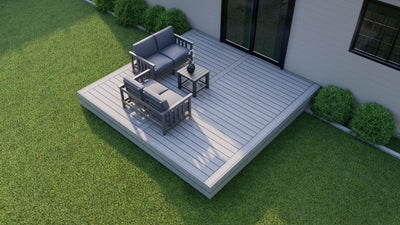
Composite decking is the most popular alternative to wood decking. Composite is made from a blend of recycled wood and plastic to give you the visual appeal of a natural wood deck without the ongoing maintenance. With the surface grain, warm tones, and board profiles, modern composite decking has become remarkably convincing.
The biggest selling points are durability and low upkeep. A quality composite deck won't rot, warp, or splinter. You don't need to seal or stain it. In most cases, cleaning it twice a year with a deck brush and some soapy water is all it takes. That's it.
Composite decking boards usually come with 25-year fade and stain warranties, and some premium lines even stretch the warranty to 50 years.
The higher upfront cost compared to raw lumber is the main reason some homeowners hesitate. But when you factor in what you'd spend on staining, sealing, and eventual replacement of a wood deck, composite typically wins on total cost of ownership over a 20-year period.
If you want the look of wood without the work, this is your best decking option. And if you're building with a pre-engineered composite deck kit, you're also cutting out the extra work of measuring and cutting boards as everything arrives pre-cut and ready to assemble.
Pros of composite deck material
- Looks like real wood.
- Minimal maintenance.
- Resists rot, splinters & fading.
- Long warranties (25–50 yr).
- Made from recycled materials.
Cons of composite deck material
- Higher upfront cost than wood.
- Can't be painted or stained.
- Gets warm in direct sunlight.
- Quality varies by brand.
2. Kiln-Dried Pressure Treated Wood Decking
A lot of people don't know that not all wood decking is the same. The stuff that warps, cracks, and rots fastest is usually standard green (wet) lumber. Kiln-dried pressure treated lumber is a different kind.
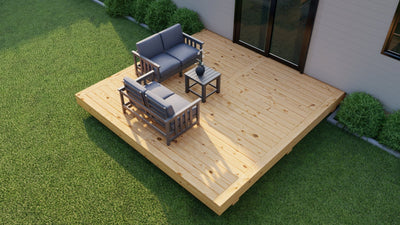
The kiln-drying process removes most of that excess moisture from the boards. That dramatically reduces the shrinking, swelling, and warping that make wet lumber such a problem. The pressure treatment then adds chemical protection against rot, decay, and insect damage. You get the natural look and feel of real wood, but with far better dimensional stability and longevity.
This is the approach used in professional contractor-grade builds with Grade 1 kiln-dried pressure treated lumber, proper joist spacing, galvanized hardware. And it makes a meaningful difference in how the deck holds up over time.
A well-built deck with quality kiln-dried lumber can realistically last 20–25 years with routine (not obsessive) maintenance.
The A-DIY pressure treated deck kit uses Grade 1 KDAT lumber with 6×6 beams, 2×8 joists spaced 13–14 inches on center, and pre-sealed deck boards. It's the same structural spec as a high-end contractor build, packaged into a kit anyone can assemble with just a drill.
Pros of KDAT Wood Decks
- Natural wood look & feel.
- More affordable than composite.
- Resistant to rot, decay & insects.
- Minimal warping when kiln-dried.
- Can be stained any color and texture.
Cons of KDAT Wood Decks
- Still requires periodic sealing.
- Heavier than composite.
- Can grey over time without care.
- Not as low-maintenance as PVC.
3. PVC Decking
PVC (polyvinyl chloride) decking is often confused with composite, but they're quite different. Composite is a combination of plastic and wood fibers. PVC is 100% synthetic with no wood content at all.
Because there's no organic material, PVC has zero risk of moisture absorption, rot, or mold. It's also impervious to insects and won't ever splinter. For homes in coastal areas, high-humidity climates, or anywhere with heavy rainfall, this total moisture resistance is a significant advantage.
That said, if low maintenance is your absolute top priority and you're less concerned about mimicking the look of natural wood, PVC decking is genuinely excellent. It can be cleaned with a garden hose and often comes with a 20–30 year warranty.
Pros of PVC decking materials
- 100% moisture resistant.
- Won't rot, mold, or splinter.
- Very easy to clean.
- Lightweight & easy to handle.
Cons of PVC decking materials
- Less convincing wood look.
- Can feel hollow underfoot.
- Can become brittle in cold climates.
- Fades faster than composite.
4. Aluminum Decking
Aluminum decking is genuinely underrated. Beyond wood, it's one of the most durable materials you can put on a deck. Aluminum is totally immune to rot, rust, mold, and insect damage. Made from recycled aluminum with a powder-coat finish, it can withstand decades of harsh weather with minimal maintenance.
It's a particularly smart choice for elevated decks or waterfront properties where moisture exposure is constant. Aluminum is also lightweight, which is an important factor when you're dealing with an elevated structure. And unlike wood or even composite, it won't contribute any fuel to a fire.
The downsides are real, though. Aluminum doesn't look like wood at all. The aesthetic is clean and modern but distinctly industrial, which won't work for every backyard. It can also get noisy in the rain unless you opt for higher-grade materials with sound-dampening features. And it gets quite hot underfoot in direct summer sun, so it's worth thinking about orientation and whether you'll need outdoor rugs.
Pros of Aluminum Decking Options
- Extremely durable (lifetime warranted).
- Fireproof decking. Great for wildfire zones.
- Immune to rust, rot & insects.
- Eco-friendly (recycled material).
Cons of Aluminum Decking Options
- Gets very hot in direct sun.
- Noisy in the rain without treatment.
- Doesn't look like wood.
- Harder to source than composite.
5. Bamboo Decking
Bamboo is technically a grass, not a wood. But processed bamboo decking planks are remarkably similar to hardwood in performance. Woven bamboo fibers are compressed under heat to create boards that are actually harder than many traditional hardwoods, with decent resistance to moisture and insects when properly treated and sealed.
Its biggest appeal is sustainability. Bamboo matures in 3–5 years, compared to 20–80 years for the trees used in traditional hardwood decking. It regenerates from the same root system after harvesting, making it one of the most renewable decking options available.
The aesthetic is modern and clean, with a distinctive grain pattern. It works particularly well in contemporary or minimalist outdoor settings.
The main limitations are availability and maintenance. Bamboo decking is harder to find than composite or pressure-treated lumber, and it does require periodic sealing to maintain its weather resistance. In very humid climates, it can still be susceptible to mold if not properly maintained. It's also a niche enough product that installation know-how can be harder to find if you run into problems.
Pros of baboo decking
- Highly sustainable & renewable.
- Harder than most softwoods.
- Modern, distinctive look.
- Lightweight & easy to work with.
Cons of baboo decking
- Requires periodic sealing.
- Limited availability.
- Can mold in humid climates.
- Less installation support.
6. Concrete & Stone Pavers / Slabs
Technically, concrete and stone pavers aren't decking in the traditional sense. But they're a legitimate alternative to wooden decking.
The range within this category is enormous. Basic concrete paving slabs start at $3–$5 per square foot and are among the most economical options for deck material. Natural stone (flagstone, travertine, slate) costs $15–$30+ per square foot. Porcelain pavers cost somewhere in the middle and are increasingly popular for their tile-like aesthetics and durability. All of them are virtually impervious to rot, insects, and fire.
The practical limitations are that avers require a properly leveled, stable base, and on uneven ground, installation can get complicated and expensive. They also can't be elevated the way a deck can, so they're not a good fit for yards with significant slope. And some stone types (travertine, for instance) are porous and need resealing every few years to prevent staining.
But for a ground-level patio space on relatively flat terrain, concrete or stone pavers can be an excellent, extremely long-lasting choice. A well-laid flagstone patio or concrete paver patio can last 30–50 years with minimal upkeep.
Pros of Concrete Decking
- Extremely durable (30–50 yr).
- Budget options available ($3+/sqft).
- Fireproof & pest-proof.
- Wide range of styles & finishes.
Cons of Concrete Decking
- Can't be elevated easily.
- Requires level ground & stable base.
- Heavy and difficult to move or change.
A Comparison of Wooden Decking Alternatives
|
Material |
Lifespan |
Maintenance |
Wood Aesthetic |
Avg. Cost / sqft |
DIY Friendly |
|---|---|---|---|---|---|
|
Composite |
25–50 years |
Very Low |
Excellent |
$30–$40 |
Yes |
|
Kiln-Dried PT Wood |
20–30 years |
Low–Moderate |
Natural |
$25–$35 |
Yes |
|
PVC |
20–30 years |
Very Low |
Moderate |
$5–$13 (materials) |
Yes |
|
Aluminum |
50+ years |
Very Low |
Poor |
$15–$35 (materials) |
Moderate |
|
Bamboo |
20–25 years |
Moderate |
Good |
$9–$11 (materials) |
Moderate |
|
Concrete/Stone Pavers |
30–50 years |
Low |
None |
$3–$50 |
Depends |
|
Standard Wood (for comparison) |
10–15 years |
High |
Natural |
$15–$25 |
Yes |
How to Pick the Right Wood Deck Alternative for Your Outdoor Space
The best wood alternatives might not be the same for everyone. So, here is a simple framework to help you narrow it down.
If low maintenance is your #1 priority
Go composite or PVC. Both require almost no upkeep beyond occasional cleaning. Composite gives you a better wood-like look; PVC is the winner in wet or coastal climates.
If you want the look and feel of real wood
Kiln-dried pressure-treated lumber or composite is your best option. Kiln-dried PT wood is the more affordable option and has genuine natural wood character. Composite gets you closer to the visual without any of the ongoing maintenance.
If you're on a tighter budget
Kiln-dried pressure treated wood offers the best value for a full structural deck. If you're open to a ground-level surface rather than an elevated deck, concrete pavers can go even lower, though the installation challenges can add back cost in labor.
If you have an uneven or sloped yard
You'll need a proper deck structure (beams, joists, footings) that can be leveled regardless of the ground beneath it. Concrete pavers aren't a realistic option here. A pre-engineered ready to assemble deck kit on adjustable posts handles slope far more easily than building from scratch.
Skip the Material Puzzle & Get a Pre-Engineered Deck Kit
There's a gap in how most people think about decking alternatives. They focus entirely on the deck surface material and treat the substructure as a separate, assumed problem. But the substructure is where most DIY deck projects go wrong.
Incorrect joist spacing causes bounce and flex. Undersized beams create structural weakness. Poor foundation choices lead to settling and shifting. These are the things that shorten a deck's life and create safety issues down the road.
Pre-engineered DIY deck kits solve this by building the engineering in. The A-DIY pressure treated deck kit, for example, uses Grade 1 kiln-dried lumber with 6×6 beams and 2×8 joists at 13–14" on center. Which is the same structural spec a professional contractor would use. The composite deck kit brings all the low-maintenance advantages of composite boards in a system that genuinely requires no cutting or measuring.
Assembly takes a few hours with a single power drill. And the cost comes in 30–50% below what a contractor would charge for the equivalent build.
If you've been putting off adding a deck because the whole process feels complicated or expensive, this is worth a look. You can get a free design consultation to figure out the right size and material for your space before you commit to anything.
Frequently Asked Questions
What is the cheapest alternative to wooden decking?
Is composite decking worth the extra cost?
For most homeowners, yes. If you account for the total cost of ownership over 20+ years, composite eliminates the annual staining, sealing, and repair costs associated with wood, and it rarely needs replacement within its warranty period.
What decking material lasts the longest?
Aluminum decking has the longest functional lifespan, 50+ years with minimal maintenance. Natural stone and concrete pavers are similarly long-lived. High-quality composite decking comes in next at 25–50 years. Kiln-dried pressure treated wood, when properly maintained, can last 20–30 years. Standard (non-kiln-dried) wood typically lasts 10–15 years before significant deterioration.
Can I build a non-wood deck myself?
Yes, absolutely. Composite, PVC, and pressure treated lumber decks are all DIY-friendly materials. Most use hidden fasteners or standard screw installation. The biggest challenge for most DIYers isn't the surface boards, it's getting the substructure right. Pre-engineered deck kits remove that challenge by providing pre-cut, pre-engineered components that fit together without any measuring or cutting.