


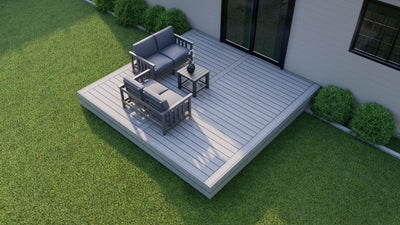


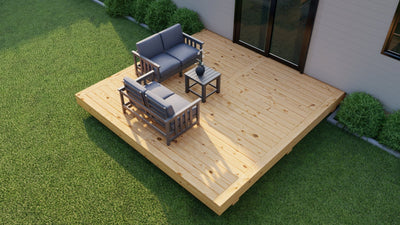


How to Build a DIY Ground Level Deck Without Heavy Tools (Step-by-Step)
Share
A ground level deck is one of the most approachable outdoor projects you can take on. You do not need a garage full of tools to end up with a platform that feels solid under your feet. With a drill and a few basic hand tools, you can build a ground level deck within a few hours. And yes, that's right. A few hours. And I will show you how.
There are two ways you can build a ground level deck. The first one is to build the deck from scratch, and the second option is to get pre-engineered DIY deck kits that require no special tools, cutting, and measuring.
If you build from scratch, you will spend more time measuring, cutting, and double-checking the layout. That can be totally fine if you already enjoy the process and have the tools, money, and time.
However, if you want to keep it drill-first, a pre-cut kit removes most cutting and measuring. A-DIY is one example of that approach, since A-DIY kits arrive pre-cut and are designed to assemble with a drill and a step-by-step guide.
The only “hard part” is getting the base level, keeping the frame square, and making sure water has a way to move away instead of sitting under or on top of your deck.
Who would want to buy an expensive saw and other heavy tools to build a ground level deck only?
Here is How to Build A DIY Ground Level Deck Without Heavy Tools
Step 1. Choose the location and size before you touch the ground
Start with water and airflow. Ground level decks sit close to the earth, so they feel the effects of moisture faster than elevated builds.
Look for a spot where water does not pool after rain. If you have a low area that stays soggy, you can still build there, but you will need more base prep to keep the deck stable and dry. Also, leave a little breathing room under the deck. Even a small amount of airflow helps the area dry out after rain and reduces that “always damp” feeling near the boards.
So, if you are planning to build a deck, you should go out after a rainy day, walk the yard, and see where the ground stays dark and soft the longest. That is usually the spot you want to avoid.
Step 2. Choose a size that fits real use
Pick the size based on what you plan to do on the deck.
-
Seating zone: two chairs and a small table sounds simple, but you will want space to pull chairs back without stepping off the edge.
-
Dining zone: once you add a table, chairs, and walking room, you usually need more square footage than you expect.
If you are looking at A-DIY kits, this step gets easier because the sizes are pre-engineered with beams and joists, and you can choose the closest match instead of designing the frame from scratch. If you share photos and rough measurements of your space, the A-DIY team can help you pick a size that fits how you actually plan to use it.
Step 3. Check permit rules early so you do not redo work
Before you dig, clear grass, or order DIY deck kit, take ten minutes and check your local permit codes. Ground level decks often come with fewer requirements than elevated decks, but the details still matter. Many areas focus on height thresholds, how close the deck sits to property lines, and whether the structure attaches to the home. If you live in a neighborhood with an HOA, it is also worth checking their guidelines so you do not end up rebuilding a corner or changing the footprint after everything is already in place.
The easiest route is to look up your city or county building authority website and search for “deck permit” and “deck height requirements.” You can also call the office and describe what you plan to build. A quick conversation can save you a weekend of redo work.
If you need drawings for your permit application, A-DIY can provide engineering diagrams to support permit applications. That can be helpful when your local office wants a simple plan view, dimensions, and basic structural notes, especially if you want to keep the project straightforward.
Step 4. Prepare the ground so the deck feels solid
It is tempting to treat a ground level deck like a big outdoor rug and place it right on the lawn. That shortcut almost always shows up later. Grass holds moisture, the soil underneath shifts, and weeds find a way through any small gap they can. Over time, that movement can make the deck feel uneven, and damp conditions under the boards can speed up wear.
A better approach starts with removing the sod where the deck will sit. And then:
-
Get the area roughly level
-
Lay a weed barrier to slow regrowth
-
Add a layer of gravel
Gravel drains better than soil, and it helps water move away instead of pooling under the frame. If you have ever stepped on a deck that feels slightly soft in one corner, there is a good chance the ground underneath was never truly prepared.
Step 5: Choose a simple foundation that does not need heavy equipment
For a ground level build without heavy tools, deck blocks, pads, or pavers on a compacted base keep things manageable. You are basically creating stable contact points that spread the load and stay consistent through weather changes. The key is not the block itself, but the base under it.
A-DIY kits include deck blocks (TuffBlocks) as part of the kit foundation. That can reduce the “which parts do I need” guesswork and keep you focused on the install instead of shopping trips.
Step 6. Build the ground-level deck frame
If you build from scratch
Building a ground-level deck frame from scratch is the part that turns a simple idea into a long project. You measure, cut, and assemble, then you square the frame by checking the diagonals. If the diagonal measurements do not match, the frame is out of square, and that can create headaches later when boards do not line up cleanly. Once it is square, you re-check the level, then you make small adjustments, then you check again. That cycle is normal, but it takes time.
This is also where small errors get expensive. One cut that is slightly short can force you to adjust spacing, re-cut a piece, or run back for another board.
If you choose pre-cut ready to assemble deck kits
If your goal is to avoid heavy tools, this is the point where a pre-cut kit can change the experience. A-DIY ready to assemble deck kits come pre-cut and require no cutting or measuring, and the only tool needed for assembly is a drill. You also get a step-by-step guide and a 3D instructional app, which helps keep the build process clear when you are working through the sequence.
If you are choosing materials right now, compare composite deck kits and pressure-treated deck kits.
Step 7. Set the height and handle uneven ground
A ground level deck sounds like it should sit almost flush with the yard, but in practice, you usually want a little lift. That small gap helps with airflow, keeps the underside from staying damp, and gives water a path to move away instead of sitting against the frame. It also makes the deck feel more finished, especially if your lawn is not perfectly flat.
For A-DIY kits, the standard kit height lands around 15–17 inches, which is a comfortable “low platform” height for most backyards. It is still easy to step up onto, but it gives you enough clearance to keep the area underneath from turning into a permanently wet zone.
If your yard is uneven
Most yards have a slope. You only notice it once you try to build something square and level.
If one side of your deck footprint sits higher than the other, do not try to “force it flat” by stacking random scraps under a corner. That is how decks end up soft or shifting after the first season. A cleaner approach is to level the deck using posts.
With A-DIY decks, you can handle uneven ground by cutting posts to the right length, or using longer posts where you need more height. For slight unevenness, we also suggest placing gravel or cement tiles under the posts to create a more stable contact point.
If you need it higher than “standard”
Sometimes you want a little more height to match a door threshold, improve drainage, or create a better view line.
You can elevate the deck using longer posts, and we recommend staying within 15–43 inches for stability. That range typically keeps things in the “platform plus a few steps” zone, which is easier to build and easier to keep rigid. If you want to go higher than that, we suggest switching to more secure support methods such as cemented footings or sonotubes.
Step 8. Install deck boards with the right spacing
Ground level decks live closer to moisture. Rain splashes up, dew hangs around longer, and airflow is naturally lower than it is under an elevated deck. That is why board spacing matters. Small gaps between deck boards help water drain through.
As a general rule, many builders aim for spacing in the 1/8″ to 1/4″ range, depending on the material and the conditions. The exact number matters less than consistency. If the gaps vary a lot, the deck can look uneven, and water may collect where you do not want it.
The common “tight boards” confusion
People often see deck boards installed tight and assume that is the “clean” way to do it. The truth depends on the moisture level of the boards at installation.
If you install wet boards, they can shrink as they dry, and the gaps appear naturally over time. If you install dry or kiln-dried boards, they usually need a gap right away because dry wood can expand with humidity and seasonal changes. When boards are installed tight with no room to move, you can end up with buckling, pressure against fasteners, or a surface that holds water longer after rain.
The simplest way to get this right is to use spacers and keep the gap consistent across the whole deck. A-DIY also recommends creating spacing between boards.
Step 9. Finish the deck construction
A deck can be technically finished and still feel awkward to use if the entry point is not thought through. Decide where you will step onto it most often. Is it from a back door, a patio path, or the yard?
If you add steps, keep them simple and safe. Place them where you naturally approach the deck, avoid creating a tight corner that feels like a trip hazard, and make sure the landing area is clear. For a low platform, even one well-placed step can make the deck feel more inviting and easier to use.
FAQs
Can I install ground-level decks on gravel?
Yes, as long as the gravel base is leveled and compacted first. Loose gravel shifts. Compacted gravel behaves.
How do I level the deck on uneven ground?
Use posts to set consistent height, then fine-tune with stable support points such as shims or cement tiles under contact areas where needed. Avoid stacking random scraps that can compress over time.
Can I raise or lower the deck later?
Often, yes. You can adjust with longer posts if you need more height, or dig down at the footing points if you need it lower. Any change is easier when the base is accessible and the support points are clean.
Do I need gaps between deck boards?
Usually, yes. Gaps help drainage and airflow. Many builds land in the 1/8″ to 1/4″ range depending on material and conditions. Keep spacing consistent across the deck.
Do I need a permit?
It varies by location. Check your local building department and any HOA rules. If you need diagrams for the application, A-DIY says they can provide engineering diagrams.
What does an A-DIY deck kit include?
A-DIY kits are described as arriving pre-cut with the needed screws and hardware, deck blocks, and an assembly guide, designed to be built with a drill.
Conclusion
A ground level deck can be a surprisingly clean project when you keep the plan simple.
We often see people choose the quickest ground prep, then realise the deck feels inches off the ground, no matter how carefully they install boards. A little extra time on leveling and compaction pays back every time you walk across it.
If you want to keep the DIY decking kits, a pre-cut kit can remove a lot of measuring and cutting stress. If you want to build the traditional way, the same prep and spacing rules still apply. Either way, start with the size you will actually use, build it well, and let the deck earn its place as a perfect hangout spot.