






Deck vs. Patio: Which Is Better for Your Home? A Cost & Value Guide
Share
You are probably here because you wonder whether a deck or a patio is the better choice for your home. It's a big decision, and honestly? There's a lot of conflicting advice out there. Some people prefer decks. Others insist patios are the smarter choice. The truth is, it depends entirely on your specific situation.
In this guide, we're going to walk through the differences between decks and patios to help you make the right choice for YOUR home. We'll cover the costs (not just installation, but long-term ownership), return on investment, how your yard's terrain affects your options, maintenance costs, and even DIY feasibility.
At A-DIY, we've helped thousands of homeowners transform their backyards with professional-grade outdoor solutions. We've seen firsthand what works for different yards, budgets, and climates. And we're here to give you the straight talk.
Quick Answer
The key difference between a deck and a patio is elevation. Decks are raised platforms built above ground level (typically using wood or composite materials), while patios are ground-level surfaces (usually concrete, brick, or stone pavers). Decks generally cost more upfront ($8,000-$25,000) but offer higher ROI (65-80%), while patios are more affordable ($4,000-$15,000) with lower ROI (50-69%) but longer lifespans.
But that's just scratching the surface. Let's get into the details.
What's the Difference Between a Deck and a Patio?
What Is a Deck?
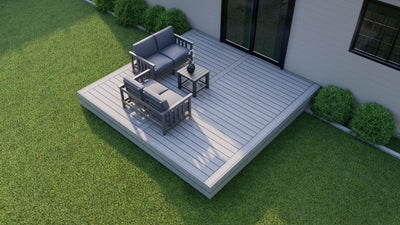
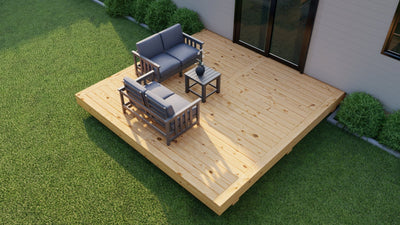
A deck is an elevated outdoor platform that's built above ground level. Think of it as an extension of your home's living space, just without walls or a roof (unless you add them later).
Decks are supported by a frame of posts, beams, and joists that elevate the surface anywhere from a few inches to several feet above the ground.
Most decks are made from pressure-treated wood, composite decking (wood-plastic blend), or PVC boards. You'll see a lot of natural wood grain, or with composite options, materials that mimic the look of wood without the same maintenance needs.
What Is a Patio?
A patio is basically the opposite approach. Instead of going up, you stay at ground level. Patios sit directly on a prepared foundation, usually a compacted gravel base with a layer of sand on top. There are no posts or beams; everything is built from the ground up.
Concrete (poured, stamped, or in paver form), brick, natural stone, or tile are the most common patio materials. You're working with masonry and hardscaping rather than lumber.
Key Structural Differences: Patio vs Decks at a Glance
Let's put this side by side so you can see the core differences:
|
Feature |
Deck |
Patio |
|---|---|---|
|
Elevation |
Raised above ground |
Ground level |
|
Support Structure |
Posts, joists, beams |
Foundation base (gravel/sand) |
|
Typical Materials |
Wood, composite, PVC |
Concrete, pavers, brick, stone |
|
Attachment |
Usually attached to home |
Attached or freestanding |
|
Railings |
Required if elevated >30" |
Not required |
|
Foundation |
Deep footings |
Shallow base |
Now that you understand the fundamental differences, let's discuss the average cost.
Deck vs. Patio Cost Breakdown
Let's talk money. Because honestly, that's probably one of the first things on your mind. This is a significant investment, and you need to know what you're getting into.
Upfront Installation Costs
Deck Costs
If you hire a contractor to build a deck, here's what you're looking at:
-
Average total cost: $8,220 to $25,096 (depending on size, materials, and complexity)
-
Cost per square foot: $25 to $55 when professionally installed
-
Wood deck (pressure-treated): $8,000 to $15,000 for a standard 300 sq ft deck
-
Composite deck: $15,000 to $25,000 for the same 300 sq ft
Those are contractor prices. But the interesting thing is that modern modular deck kits can cut those costs by 30-50%. How? By eliminating the labor expense.
For example, A-DIY's professional-grade DIY deck kits come as pressure treated deck kits and composite deck kits that can be assembled in under an hour with just a power drill, where you need no contractor, no hidden labor costs, and no waiting weeks for someone's schedule to open up. You're looking at significant savings while still getting professional-quality results.
Patio Costs
Patios start lower on the cost spectrum:
-
Average total cost: $4,000 to $15,000
-
Cost per square foot: $15 to $50 when professionally installed
-
Concrete patio: $4,000 to $8,000 for 300 sq ft (basic poured concrete)
-
Paver patio: $8,000 to $15,000 for 300 sq ft (brick or stone pavers)
-
Brick/stone patio: $10,000 to $20,000+ for 300 sq ft (natural stone is pricey)
On paper, patios look like the budget winner. And for upfront costs, they usually are. But we're not done with the cost conversation yet.
Hidden Costs & Additional Expenses
Both decks and patios come with potential add-ons that can quickly inflate your budget. Let's get real about what those might be.
Deck Additional Costs
-
Permits and inspections: $200 to $500 (depends on your locality)
-
Stairs: $1,000 to $3,000 (if you need to get from your deck to the yard)
-
Railings: $20 to $60 per linear foot (required for a raised deck)
-
Lighting: $300 to $2,000 (post cap lights, stair lights, recessed lighting)
-
Roof or pergola: $3,000 to $10,000 (if you want shade or weather protection)
Patio Additional Costs
-
Site excavation/leveling: $500 to $2,000 (if your yard isn't already level)
-
Drainage systems: $500 to $1,500 (French drains or channel drains for water management)
-
Retaining walls: $2,000 to $10,000 (if you're dealing with slopes)
-
Patio cover or pergola: $3,000 to $10,000 (same as decks—shade costs money)
The takeaway? Budget an extra 20-30% beyond the base installation cost for either option, just to be safe.
True Lifetime Cost Comparison
Let's do the math over a 20-year ownership period. This is the real cost of ownership:
-
Wood deck: $12,000 initial + $15,000 maintenance = $27,000 total
-
Composite deck: $20,000 initial + $3,000 maintenance = $23,000 total
-
Concrete patio: $6,000 initial + $4,000 maintenance = $10,000 total
Key Takeaway: While patios have lower upfront costs, composite decks can be cost-competitive over 20+ years due to minimal maintenance. And with DIY decking, you can bridge the cost gap significantly by eliminating labor expenses.
Cost is just one piece of the puzzle. Let's look at what you're actually getting for your investment.
Return on Investment (ROI) & Home Value
If you're thinking about resale value or just want to make a smart financial decision, keep reading.
Resale Value & ROI Statistics
Deck ROI
According to Remodeling Magazine's Cost vs. Value Report, decks are one of the better outdoor investments you can make:
-
Wood deck: 65-72% ROI
-
Composite deck: 63-66% ROI
-
Average value added to home price: $7,000 to $15,000
So, if you spend $15,000 on a deck, you can expect to recoup about $10,000+ when you sell your home. That's a pretty solid return compared to many home improvements.
Patio ROI
Patios don't quite hit the same numbers:
-
Concrete patio: 50-55% ROI
-
Paver patio: 55-69% ROI
-
Average value added to home price: $3,000 to $8,000
An $8,000 patio investment might add about $4,500 to your home's value. Not bad, but noticeably lower than decks.
Why Decks Have Higher ROI
You might be wondering: Why do decks outperform patios when it comes to boosting your home's value?
It comes down to perception and functionality.
-
1. Visual appeal and elevation create a "wow factor." When potential buyers walk through your home and see a beautiful deck extending from your living space, it makes an impression.
-
2. Viewed as a luxury upgrade vs. basic hardscaping. Rightly or wrongly, buyers see decks as upscale additions, while patios are sometimes seen as "just concrete".
-
3. Extends functional square footage of the home. A deck literally adds livable space to your home. It's like an extra room, and buyers count that in their mental calculations.
-
4. More popular in real estate listings. Deck is a searchable and extra feature in real estate listings. Buyers specifically filter for it.
-
5. Better suited for entertaining (perceived value). Whether it's true or not, decks have a reputation as entertainment spaces. That's valuable to buyers.
Best ROI Strategy
Here's the bottom line:
For the highest ROI, choose a deck if you plan to sell within 5-10 years. If you're staying long-term and want the lowest total cost, a patio makes sense. However, with DIY deck kits, you can get deck-level ROI at near-patio installation costs, offering the best of both worlds.
Modular deck systems like A-DIY's ready-to-assemble deck kits change the traditional cost equation. By assembling it yourself in under an hour, you save $5,000-$10,000 in labor costs while still getting the high ROI benefits of a professional-grade deck. That means a $10,000 DIY deck kit could add $7,000-$8,000 to your home's value, a potential 70-80% return.
That's hard to beat.
ROI is important, but your outdoor space also needs to work with your specific yard. Let's talk terrain.
Maintenance Requirements
Let's get real about maintenance. Some people love weekend projects. Others would rather spend that time actually enjoying their deck or patio. Neither approach is wrong, but you need to know what you're signing up for.
|
Maintenance Factor |
Wooden Decks |
Composite Decks |
Concrete Patio |
|---|---|---|---|
|
Annual Time |
8-12 hrs |
2-3 hrs |
3-5 hrs |
|
Skill Required |
Moderate |
Easy |
Easy |
|
Annual Cost |
$500-$2,000 |
$100-$300 |
$100-$500 |
|
Major Refresh |
Every 2-3 yrs |
Never |
Every 5 yrs |
|
Lifespan |
10-15 yrs |
25-30 yrs |
25-50 yrs |
Maintenance Winner
Lowest Maintenance Overall: Composite Decks and Concrete Patios (tie)
Both require minimal ongoing work. However, don't let maintenance scare you away from decks. Modern composite materials have completely changed the game, as you get the elevated benefits of a deck with patio-level ease of care. And if you build with a modular system, individual board replacement is as simple as unscrewing and swapping.
Maintenance is about the long game. But what about construction? How long until you can actually enjoy your new outdoor space?
Installation Time & Difficulty
Time is money. But it's also your weekends and your ability to actually use your outdoor space.
Professional Installation Timelines
Deck Installation (Hired Contractor)
If you go the traditional route and hire a contractor, here's the realistic timeline:
-
Design and permitting: 2-6 weeks (this is often the longest part—bureaucracy is slow)
-
Actual construction: 1-3 weeks (weather dependent—rain stops everything)
-
Total timeline: 3-9 weeks from decision to completion
Factors that affect timeline:
-
Weather delays (you can't install deck boards in the rain)
-
Inspector availability for permit inspections (they're always "backed up")
-
Contractor scheduling during busy season (good luck getting someone in June)
-
Material delivery delays (supply chain issues are still a thing)
Winner: Patios (faster professional installation)
DIY Installation Difficulty & Time
DIY Deck (Traditional Build)
Let's be honest: building a traditional deck from scratch is hard.
-
Difficulty: Hard (requires legitimate carpentry skills)
-
Time commitment: 2-4 weekends (60-100 hours if you actually know what you're doing)
-
Tools required: Circular saw, miter saw, power drill, level, post hole digger, speed square, framing square... the list goes on ($500-$2,000 in tools if you're starting from scratch)
Skills you actually need:
-
Measuring and cutting accurately (measure twice, cut once is real)
-
Post hole digging and concrete mixing (back-breaking work)
-
Understanding building codes (you need to know what's legal)
-
Joist installation and proper spacing (structural integrity matters)
-
Ledger board attachment (this is where most DIY disasters happen)
Success rate: 60-70% (many DIYers end up hiring professionals partway through)
DIY Deck (Modular Kit System)
Now here's where the game completely changes.
-
Difficulty: Easy (genuinely no carpentry skills needed)
-
Time commitment: 1-4 hours (yes, hours—not days, not weekends, HOURS)
-
Tools required: Power drill (that's literally it)
-
Skills needed: Ability to use a drill and follow illustrated instructions
-
Success rate: 95%+ (designed specifically for DIY success)
Modern modular deck systems like A-DIY completely eliminate the traditional DIY challenges.
-
No cutting or measuring is requires as everything is pre-cut and precision-engineered at the factory.
-
No complex joist installation as the support structure comes pre-built.
-
No permit confusion as ground-level kits typically don't require permits in most jurisdictions
-
Simple assembly. Pieces fit together like LEGO blocks (we're not exaggerating)
-
Construction In under an hour
-
One person can do it
DIY Patio (Concrete)
-
Difficulty: Very Hard (honestly not recommended for DIY unless you have experience)
-
Time commitment: Full weekend minimum
-
Skills needed: Heavy physical labor, mixing concrete properly, screeding, finishing techniques
-
Success rate: 40-50% (high failure rate due to uneven terrain, and cracking are common)
Our advice? Don't DIY poured concrete unless you've done it before. Hire a pro for this one.
DIY Comparison Summary
|
DIY Factor |
Traditional Deck |
Modular Deck Kit |
Concrete Patio |
|---|---|---|---|
|
Difficulty |
Hard |
Easy |
Very Hard |
|
Time |
60-100 hrs |
1-4 hrs |
20-30 hrs |
|
Tools Needed |
$500-$2,000 |
$50 (drill) |
$300-$800 |
|
Skills Required |
Carpentry |
Drill operation |
Concrete work |
|
Recommended? |
Only if experienced |
YES! |
No (hire pro) |
The DIY Game-Changer
Traditional deck building is genuinely difficult. That's why 70% of homeowners hire contractors and then wait weeks while paying premium prices.
But modular deck kits have revolutionized the game. You get contractor-quality results in a fraction of the time, with zero carpentry skills required. It's not just easier, and it's actually enjoyable.
Steve from California told us, "I'm not the handiest person, but A-DIY's instructions were so clear that I had my deck up in under an hour. The material cost was a fraction of what I was quoted by contractors, and the quality is fantastic."
Final Decision Checklist for Choosing Deck or A Patio
Use this checklist—tally your checkmarks to see which option fits your needs:
|
I need this... |
Deck |
Patio |
|---|---|---|
|
Works on sloped yard |
✓ |
|
|
Lowest upfront cost |
✓ |
|
|
Highest ROI |
✓ |
|
|
Easiest DIY (with modern kits) |
✓ |
|
|
Easiest DIY (traditional) |
✓ |
|
|
Best for cold climate |
✓ |
|
|
Best for hot, arid climate |
✓ |
|
|
Elevated views |
✓ |
|
|
Landscape integration |
✓ |
|
|
Lowest maintenance |
✓ (composite) |
✓ |
|
Accessibility/no stairs |
✓ |
|
|
Fire pit friendliness |
✓ |
|
|
Hot tub support |
✓ |
|
|
No permits (usually) |
✓ (ground-level) |
✓ |
The bottom line is that there's no universally "better" option, only what's better for YOUR home, budget, and lifestyle.
The Bottom Line
Choose a DECK if you have sloped terrain, want higher ROI, need elevation for views, live in cold or humid climates, or value a defined outdoor living space attached to your home.
Choose a PATIO if you have flat land, need the lowest upfront cost, want seamless landscape integration, prioritize accessibility, or live in hot, arid climates.
Modern modular deck kits have eliminated many traditional trade-offs. You can now get deck-level ROI and benefits at approachable costs, with DIY assembly so simple that anyone can do it in under an hour.
Your Perfect Outdoor Space Is Closer Than You Think
Explore A-DIY's professional-grade modular deck kits for easy assembly, priced to save you thousands, and backed by real customer success stories. Get a free design consultation or browse modular deck kits now.
FAQs
Is it cheaper to build a deck or patio?
Patios are generally cheaper upfront. A 300 sq ft patio costs $4,000-$15,000, while a comparable deck costs $8,000-$25,000. However, when you factor in DIY deck kits, the cost gap narrows significantly. A-DIY's modular deck kits can cost 30-50% less than contractor-built decks, making them competitive with patio prices while offering higher resale value (decks have 65-80% ROI vs. patios' 50-69% ROI).
Which lasts longer, a patio or deck?
Patios typically last 25 to 50+ years with minimal maintenance. Wood decks last 10-15 years, while composite decks last 25-30 years. However, composite decks approach patio longevity while requiring less maintenance than traditional patios.
Can you build a deck yourself?
Yes, but traditional deck building requires significant carpentry skills and 60-100 hours of work. However, modern modular deck kits like A-DIY are designed for anyone to assemble in under an hour with just a power drill.
What's a better choice for a sloped yard, deck or patio?
Decks are far better for sloped yards. They're designed to be built on uneven terrain using adjustable support posts. Patios require flat ground and would need expensive grading, retaining walls, and drainage work on a slope, often costing more than building a deck. For any yard with more than 5% slope, choose a deck.