






Backyard Deck Ideas on a Budget: How to Build and Style a Beautiful Outdoor Space Without Overspending
Share
A backyard deck is one of the most rewarding upgrades a homeowner can make. It extends your stylish outdoor space, elevates the look of your home, and creates a place where life happens. However, most people assume it's going to cost them a fortune.
Let me tell you that the biggest expense in any deck project isn't the materials. It's the labor. According to HomeAdvisor, professional deck installation can run anywhere from $30 to $60 per square foot once contractor fees are factored in. That means a modest 12x16 deck can set you back $5,000 to $11,000, before you've bought a single piece of furniture.
But a beautiful deck on a budget is completely achievable when you make smart decisions from the very beginning. This guide walks you through the best backyard deck ideas on a budget so you can decorate your space for a fraction of what most people spend.
How Much Does a Backyard Deck Actually Cost?
Before the affordable backyard deck ideas, it helps to understand where your money actually goes. A typical outdoor deck and patio budget breaks down roughly like this:
-
Materials (lumber, boards, hardware, footings): 40–60% of total cost
-
Labor (contractor): 40–60% of total cost
-
Extras (stairs, railings, permits): variable
So, if you can eliminate or dramatically reduce labor costs, you can have a high-quality deck at a fraction of what your neighbor paid.
A pressure-treated floating deck, for example, built by a homeowner with a kit or pre-cut materials, can cost $1,500 to $4,000 in materials, versus $8,000 to $15,000+ installed by a contractor for the same deck size.
Backyard Deck Ideas On A Budget in 2026
Idea 1. Go Ground-Level: The Most Budget-Friendly Deck You Can Build
A ground-level or floating deck is the single best choice for homeowners working within a budget.
Here's why it saves you so much money:
-
No ledger board required. Attached decks need to be connected to your home's structure, which adds complexity, hardware, and often a mandatory permit. A freestanding, ground-level deck skips all of that.
-
Minimal footings. Ground-level decks typically sit on surface-mounted deck blocks or small concrete pads rather than deep footing posts, which cuts both material cost and labor significantly.
-
No railing required in most jurisdictions. Decks under 30 inches off the ground generally don't require railings under local building codes, which can save $500 to $2,000.
-
Permits may not be required. Many municipalities exempt ground-level freestanding decks from permit requirements entirely; always verify with your local authority, but this can simplify your DIY project considerably.
A 10x12 or 12x16 ground-level deck is often the sweet spot. which is large enough to fit an outdoor dining set and a few chairs, small enough to build in a weekend, and affordable enough to leave room in your budget for the finishing touches that make a deck feel like a stylish outdoor room.
Idea 2. Choose the Right Material From the Start
Material choice is the decision that shapes your budget for building a patio or backyard deck.
Pressure-Treated Lumber: Lower Upfront Cost
Pressure-treated (PT) lumber is the most affordable decking material on the market, typically running $3 to $7 per square foot for the deck boards. It's strong, widely available, and perfectly capable of lasting 15+ years with proper care.
However, pressure-treated wood requires regular maintenance. Plan to clean and reseal it every 1 to 3 years to prevent splitting, warping, and graying. Over a 10-year period, the maintenance costs can add up. For homeowners who don't mind the seasonal upkeep routine, it's a cost-effective starting point.
Composite Decking: Better Long-Term Value
Composite decking costs more upfront, typically $20 to $38 per square foot installed, but changes the math over time. Quality composite boards don't warp, splinter, or fade significantly, and they require almost no maintenance beyond an occasional rinse. Many come with 25-year warranties, meaning one good investment can last the life of your home.
If you're going to DIY the labor anyway (more on that below), composite decking becomes genuinely affordable. Because the materials cost more, but you're not paying someone else to install them. You get a low-maintenance, high-end finish at a total project cost that beats a contractor-installed PT deck.
So, if you're cost-constrained right now, pressure-treated lumber is a solid choice for the subfloor and structure. It's what professional builders use under composite boards anyway.
Idea 3. Do the Labor Yourself
We've already established that labor can represent half your total project cost. Eliminating it is the single highest-impact budget decision you can make.
The challenge, of course, is that traditional deck building isn't beginner-friendly. You need to measure, cut, frame, square, and fasten. Even if you get everything right, one mistake in framing can ripple through the entire build. That's why so many homeowners end up calling a contractor.
This is where the concept of a pre-engineered DIY deck kit changes everything. Unlike buying lumber at a big box store and figuring it out from scratch, a quality deck kit arrives with every component pre-cut, pre-measured, and designed to fit together precisely.
At A-DIY, our DIY deck kits are engineered so that any homeowner, even with zero construction experience, can assemble a contractor-grade deck using nothing but a power drill.
Every piece fits together like a well-designed puzzle. Customers regularly complete mid-size decks in a single afternoon and report saving $5,000 to $8,000 compared to contractor quotes for the same footprint.
If you're planning a deck on a budget, eliminating labor is your biggest lever. A ready-to-assemble deck kit makes that realistic for anyone.
Idea 4. Right-Size Your Deck, Then Expand Later
One of the most common budget mistakes is trying to build the "final" deck from day one. Homeowners overextend, the project stalls, or the budget runs dry before the decorating ever happens.
It's important to build a right-sized deck now, then expand it as your budget allows.
What "right-sized" means in practice:
-
A 10x10 or 10x12 deck is enough for a seating area or a 4-person dining set.
-
A 12x16 or 12x20 fits both a dining space and a lounge corner.
-
You don't need to deck your entire yard on day one.
Modular deck systems are particularly well-suited to this approach. Because the components are designed to connect seamlessly, you can add a second kit later to extend your deck's length or width without rebuilding what's already there.
6 Deck Decorating Ideas on a Budget to Finish Your Deck
Once your deck is built, the transformation from "wooden platform" to "outdoor room" costs far less than most people expect. These finishing ideas are high-impact and budget-friendly.
1. String Lights is the Easiest $30 Upgrade
Nothing changes the atmosphere of an outdoor living space faster than string lights. A set of warm Edison-bulb or globe string lights draped over a simple DIY wood frame or hung from the eaves of your home creates an outdoor ambiance that looks like it cost ten times what it did. Solar-powered options eliminate the need for an outdoor outlet entirely. Budget: $25 to $60.
2. An Outdoor Rug to Define the Space
An outdoor rug does something powerful: it transforms a deck from a construction surface into a room. It defines seating areas, adds softness and color, and covers any imperfections in older decking. Look for polypropylene rugs, which are UV-resistant, easy to clean, and surprisingly durable. End-of-season sales at major retailers can get you an 8x10 for under $80. Budget: $50 to $150.
3. Container Plants and a Privacy Screen
Plants add life to any deck and cost very little. A few large planters with ornamental grasses or climbing vines placed along the perimeter create a sense of enclosure and privacy without building a fence. Tall bamboo in a narrow planter box is one of the most effective (and affordable) privacy screens available. Thrift stores and dollar stores often carry inexpensive ceramic or resin pots. Budget: $40 to $150 for a full border.
4. Second-Hand Furniture
Outdoor furniture is one area where the second-hand market genuinely delivers. Facebook Marketplace, Craigslist, and local estate sales regularly feature quality outdoor sets — wrought iron, teak, and aluminum — for a fraction of retail price. A can of spray paint in a matte black or warm white can refresh almost any metal frame, and replacement cushions can be sourced inexpensively from big box retailers. Budget: $50 to $200 for a full set, sourced second-hand.
5. Solar Deck and Step Lights
Solar-powered step lights, post cap lights, and path lights require no wiring, install in minutes, and add both safety and ambiance. Place them along stair risers, deck railings, or the perimeter path leading to your deck. Quality solar lights have improved dramatically in the last few years — many are indistinguishable from hardwired fixtures once the sun goes down. Budget: $30 to $80 for a complete lighting plan.
6. A Shade Sail or Pergola
If your budget allows for one bigger-impact addition after the deck is built, a shade sail is one of the best bang-for-buck upgrades available. Attach three anchor points (two fence posts or wall hooks and one eye bolt) and hang a UV-resistant polyester sail to create instant shade for less than $50. For a more permanent look, a basic pergola kit, which can often be assembled by two people in a half-day, transforms the feel of the entire space. Budget: $40 to $80 for a shade sail; $300 to $800 for a basic pergola kit.
Frequently Asked Questions About Budget Backyard Decks to Build a Pleasant Outdoor Space
What is the cheapest type of deck to build?
A ground-level floating deck built with pressure-treated lumber is the least expensive deck option. It requires minimal footings, no ledger board connection to your home, and often no permit in many jurisdictions. Using a pre-engineered deck kit further reduces waste and simplifies the build.
How much does a DIY deck cost compared to hiring a contractor?
DIY deck material costs typically range from $1,500 to $5,000 depending on size and material choice. Contractor installation for the same deck usually runs $6,000 to $15,000+. The labor savings alone are the strongest argument for doing it yourself.
Can I build a deck with no experience?
Yes, especially with a pre-engineered kit. Traditional deck building from raw lumber requires some carpentry skill and comfort with power tools. But pre-cut, precision-fit deck kits are designed specifically for homeowners with no prior construction experience.
What's the most budget-friendly way to furnish a deck?
A combination of second-hand outdoor furniture (refreshed with spray paint and new cushions) and high-impact, low-cost accessories such as string lights, an outdoor rug, and container plants.
Ready to Start? Here's Your Next Move.
The biggest thing standing between most homeowners and their backyard deck is the feeling that building a deck is complicated, time-consuming, or requires skills they don't have.
It doesn't have to be any of those things.
At A-DIY, we've spent years engineering deck kits that remove the barrier of measuring, cutting, and contractor fees.
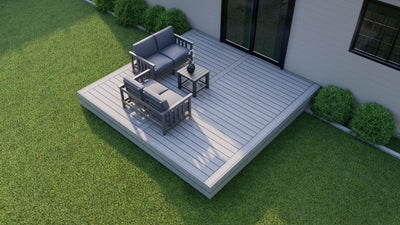
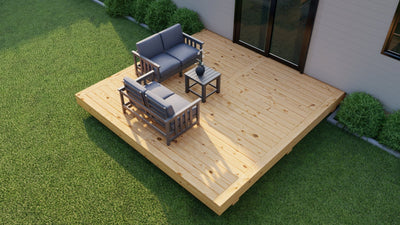
Our kits come in two options to suit any budget: a pressure-treated lumber deck kit for the most cost-conscious buyers, and a composite deck kit for those who want a beautiful, low-maintenance finish with a 25-year warranty.
Both ship nationwide, complete with everything you need to build. Not sure which size fits your space?
Our design specialists offer free consultations. Send us your measurements and photos, and we'll help you find the perfect fit.